Chinese ceramics, renowned for their technological innovation, exquisite beauty, and profound cultural significance, hold a unique and pivotal position in global art history. For millennia, China not only perfected the art of pottery but also gifted the world the discovery of true porcelain, a material so coveted it became synonymous with Chinese culture and a major force in global trade.
Chinese Ceramics — Culture, Origin, and Historical Development
Chinese ceramics, renowned for their technological innovation, exquisite beauty, and profound cultural significance, hold a unique and pivotal position in global art history. For millennia, China not only perfected the art of pottery but also gifted the world the discovery of true porcelain, a material so coveted it became synonymous with Chinese culture and a major force in global trade.
1. Origin and Early History
Neolithic Period (c. 18,000 - 2000 BC):
The earliest Chinese pottery dates back to the Palaeolithic era, with fragments found in Xianrendong Cave (Jiangxi Province) dating to around 18,000 BC, among the oldest in the world.
Yangshao Culture (c. 5000-3000 BC): Known for its distinctive painted pottery (caitao). Artisans decorated red clay vessels with black pigments featuring geometric, floral, and animal motifs.
Longshan Culture (c. 3000-2000 BC): Famous for its sophisticated black eggshell pottery. These incredibly thin, delicate, and polished black cups and beakers were likely used for ritual purposes, demonstrating a high level of technical skill.
Painted Pottery Eggshell Pottery
2. Development of Chinese Ceramics
Shang and Zhou Dynasties (c. 1600–256 BC):
The emergence of high-fired stoneware and the revolutionary invention of glaze. During the Shang Dynasty, artisans discovered that applying ash to the pottery's surface during high-temperature firing would melt into a natural glaze. This resulted in primitive celadon-type glazes, creating a strong, waterproof surface.
Han Dynasty (206 BC – 220 AD):
A period of major advancement. Pottery technology spread widely, and the use of lead-based glazes became common, allowing for vibrant green and brown colors. The most famous Han ceramics are the burial goods, including highly detailed models of houses, farms, towers, and figures—meant to provide for the deceased in the afterlife. This practice reflected the cultural beliefs in ancestor worship and the afterlife.
Tang Dynasty (618–907 AD):
China’s “Golden Age,” and a glorious period for ceramics. Tang wares were famous and exported via the Silk Road.
Three-colored (sancai) Glaze: The most iconic Tang style. Lead-fluxed glazes in amber, green, and cream (sometimes blue) were splashed freely on earthenware figures of horses, camels, and foreign merchants. These were almost exclusively burial objects.
Yue Celadon: The first major celadon ware, produced in the Yue kilns in the south. It featured a fine, olive-green glaze and was highly valued, even mentioned in poetry.
Early White Wares: The pursuit of pure white ceramics began, laying the groundwork for porcelain.
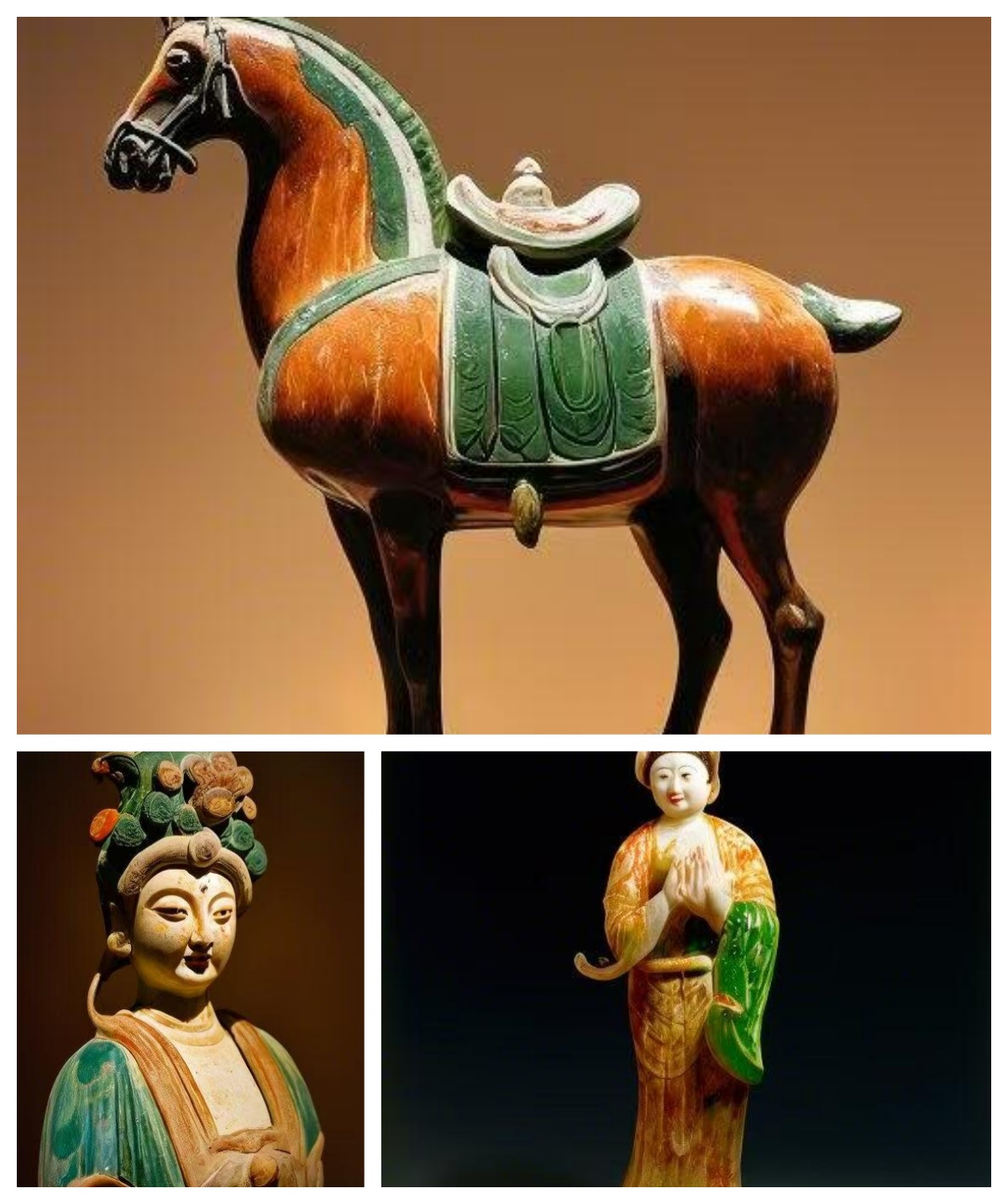
Three-colored Glaze
Song Dynasty (960–1279 AD):
The classical period of Chinese ceramics, revered for its refined elegance, subtlety, and emphasis on perfect form and glorious glaze. Aesthetic ideals were influenced by Daoism and Confucianism, favoring restraint and natural beauty.
The Perfection of Celadon: The Longquan kilns produced celadon of an unparalleled jade-like, sea-green color.
The “Five Great Kilns”: Ru, Guan, Ge, Jun, and Ding kilns produced exquisite wares, often for imperial use. Each was famous for a specific characteristic: the mysterious “cracked ice” crackle of Guan ware, the lavender splashes of Jun ware, and the precise, ivory-white Ding ware.
Qingbai Ware: A forerunner to blue-and-white, this porcelain had a faint bluish-tinted glaze.
The Song Dynasty was renowned for its rites and rituals. The tradition of reciprocity, which endured for millennia, nurtured the creation of countless exquisite treasures from the ancient Chinese nation. Two thousand years ago, bronze vessels were used as gifts, offering tributes to heaven and earth, the emperor, and to friends and family. Bronze civilization flourished for a time. However, since the birth of ceramics, bronze vessels faded out of people’s life. Ceramics, incorporating the spirit of nature and artisan’s craftsmanship becoming increasingly exquisite, have gradually become the mainstream of ceremonial vessels. Giving ceramics as gifts has been a new tradition for thousands of years, and the gift culture embodied that ceramics began to play an important role in the history.
Yuan Dynasty (1271–1368 AD):
Though a period of Mongol rule, it was crucial for future development. The underglaze blue technique, using cobalt pigment from Persia, was perfected. This set the stage for the iconic blue-and-white porcelain of the next dynasty.
Ming Dynasty (1368–1644 AD):
The era of global export and iconic blue-and-white.
Blue-and-White Porcelain (qinghua): Became the most famous Chinese ceramic worldwide. The Yongle and Xuande reigns are considered the pinnacle of this art. Vases, dishes, and jars are painted with intricate Chinese landscapes, dragons, flowers, and late adapted for the export market.
Imperial Kiln at Jingdezhen ( porcelain capital ): This city in Jiangxi province became the undisputed porcelain capital of the world, a title it still holds. Production was organized on an industrial scale because of the huge market demand.
Other Styles:
Doucai (contrasting colors) and
Wucai(five-color) overglaze enamel techniques added vibrant reds, yellows, and greens to the palette.
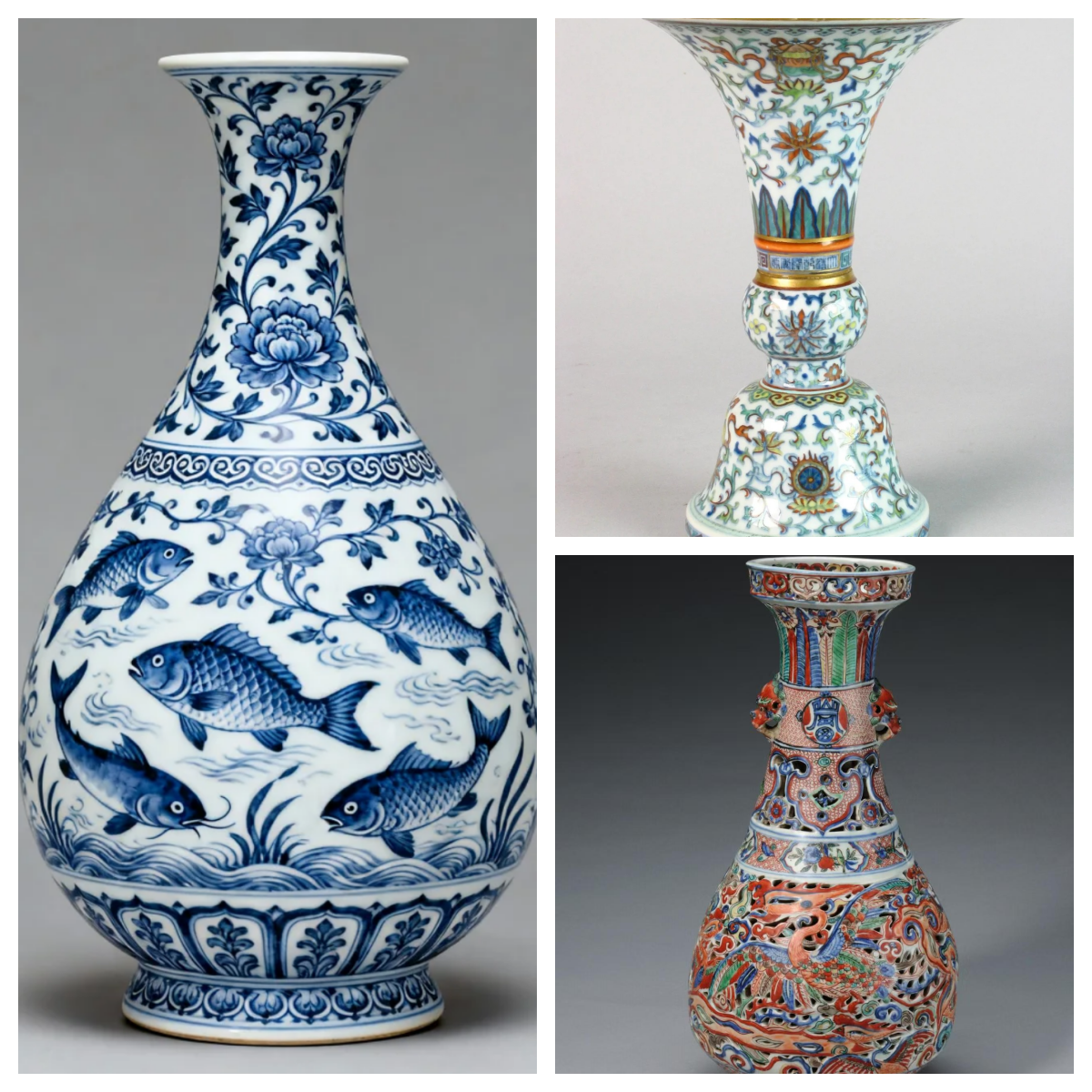
Blue-and-White Doucai(top right) Wucai(bottom right)
Qing Dynasty (1644–1912 AD):
Technical virtuosity reached its peak, often characterized by elaborate designs and brilliant colors.
Kangxi Reign: Mastered the famille verte (green family) enamel palette.
Yongzheng Reign: Famous for its exquisite famille rose (pink family) ware, which introduced a new pink tone from gold chloride, allowing for softer, more painterly designs.
Qianlong Reign: Ceramics became incredibly ornate, complex, and technically perfect, sometimes imitating other materials like bronze or lacquer. While breathtaking, it often reflected a shift towards technical showmanship over the subtle elegance of the Song period.
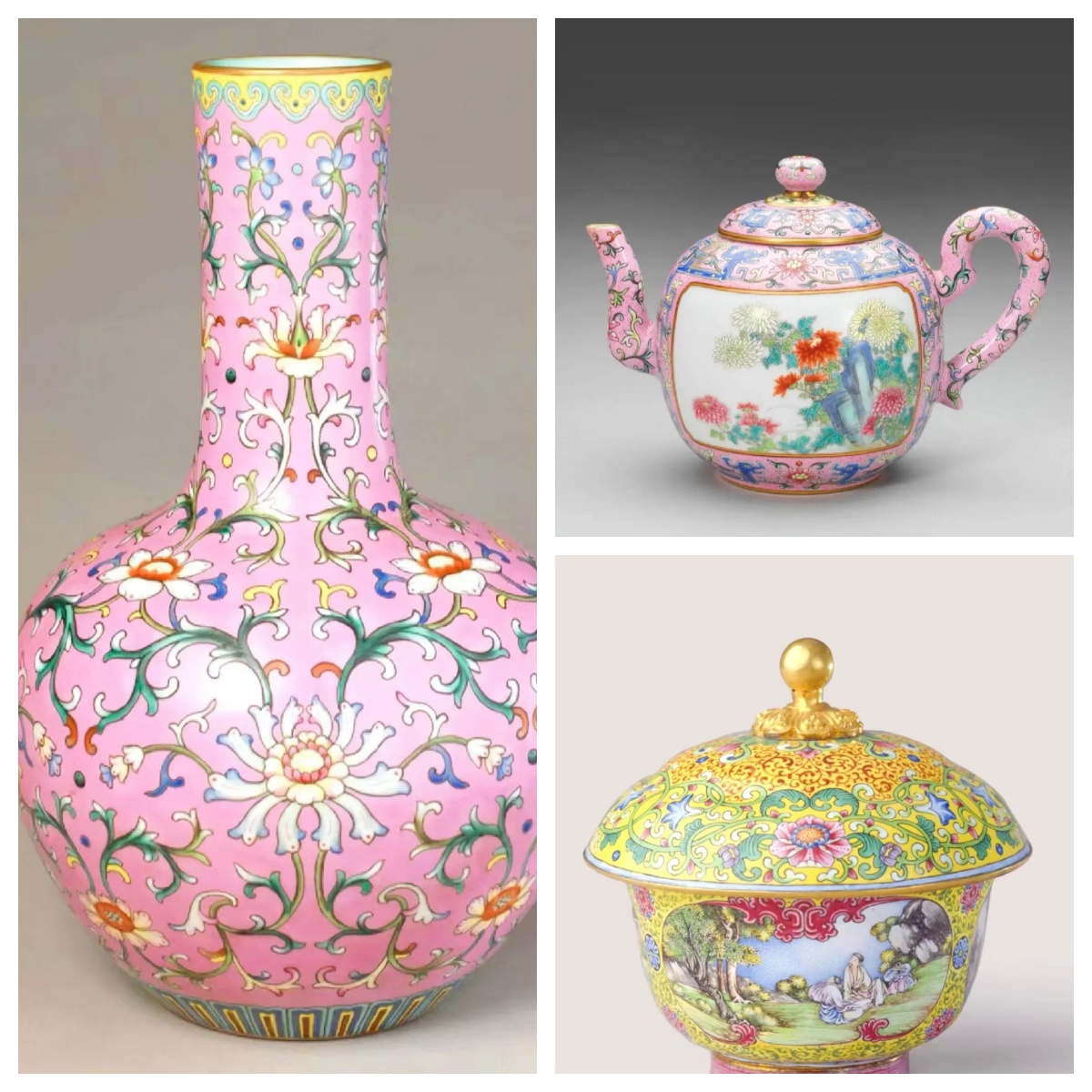
Enamel
3. Cultural Significance
Chinese ceramics are deeply woven into the fabric of China’s culture, history, and economy.
Status and Imperial Patronage: The best wares were made for the imperial court. Specific styles, colors (like imperial yellow), and dragon motifs were reserved solely for the emperor.
Philosophical Expression: Song Dynasty wares, in particular, reflect Daoist ideals of simplicity, harmony, and a reverence for nature. The imperfections and variations in celadon glazes were celebrated, seen as embodying the natural world.
Funerary Practices: From the Terracotta Army of Qin Shi Huang to Han mingqi and Tang sancai figures, ceramics played a vital role in burial rituals and beliefs about the afterlife.
Global Trade and Influence: Chinese porcelain was one of China’s first globalized luxury goods. It flowed along the Silk Road and later via European trading companies, creating a worldwide craze ("china-mania"). It profoundly influenced ceramic traditions in Europe (e.g., Meissen, Delft), the Islamic world, and Southeast Asia.
Poetry and Literature: Fine ceramics were celebrated in poetry and literature, symbolizing purity, elegance, and cultural refinement. For example, Keat’s Ode on a Grecian Urn. The poem aims to tell the readers that truth is beauty, beauty is truth.
In Modern and Contemporary Era, the Jingdezhen kilns continues producing numerous exquisite porcelains. Most of them are hand-painted by masters. People from home and abroad come to visit this charming city. Today, there is a vibrant revival. Chinese artists and studios are reinterpreting traditional techniques while engaging with global contemporary art trends. They bridge the gap between ancient heritage and modern expression, ensuring the art form remains alive and further prosperous.


